
Introduction
When was the last time someone on your team opened a workplace first aid kit just to check it, not to grab a bandage in a rush? How sure are you that every bandage, antiseptic wipe, and trauma pad inside is clean, in date, and ready to use? If someone collapsed or suffered a deep cut right now, would your first aid kit maintenance pass that real test or quietly fail?
Many organizations buy first aid kits, mount them on the wall, tick the compliance box, and then forget about them. Months or years later, the first real test is an OSHA inspection or a serious injury. That is when expired ointments, half-empty boxes, missing gloves, and broken latches turn into real risks for the person on the floor and for your business.
First aid kit maintenance is not a one-time purchase or a once-a-year chore. It is an ongoing system that keeps your kits ready, your people protected, and your records clean when regulators ask questions. In this guide, you will see how to build a clear inspection and restocking schedule, how OSHA and ANSI standards really work, how to handle expired items, and when it makes sense to bring in outside help. By the end, you will have a practical playbook you can use across every site you manage.
Key Takeaways
Clear OSHA And ANSI Alignment. You will see how OSHA rules and ANSI standards fit together, so you can show that your first aid kit maintenance program meets clear safety expectations. This gives you a simple path from vague rules to concrete action and written proof when inspectors visit.
Three-Level Inspection Rhythm. You will learn a three-tier inspection rhythm that covers weekly quick checks, deeper monthly reviews, and immediate post-incident restocking. This rhythm keeps kits ready without adding heavy admin work and helps you spot problems long before they become safety gaps.
Safe Handling of Expired Supplies. You will understand how to spot expired or damaged supplies and what to do with them once they leave the kit. You will see safe disposal options and smart ways to reuse items for training or education. This keeps people safe while avoiding pure waste.
Cost-Conscious Restocking. You will get ideas for smart restocking, bulk buying, and cost control, plus when to keep maintenance in-house or use professional services. This helps you balance safety, time, and budget. It also shows where a partner like First Aid Longs can support you with steady, high quality supplies.
Why Regular First Aid Kit Maintenance Is Non-Negotiable For Workplace Safety

A serious injury rarely gives anyone time to think. In those first sixty seconds, the only things that matter are nearby people and whatever supplies they can reach. Regular first aid kit maintenance turns that plastic box on the wall from a prop into a real first line of care. Without a steady system, kits slowly slide toward missing items, broken packaging, and expired products that do little or nothing when a worker needs help.
From a safety point of view, a maintained kit can keep a minor cut from turning into an infected wound that needs days off work. Clean gauze, strong tape, and fresh antiseptic can slow bleeding, protect tissue, and cut down on complications. In more serious cases, fast access to trauma pads and gloves can stabilize a person until emergency medical services arrive. When kits are messy or half empty, that early window is lost while someone runs around looking for basic items that should have been ready.
Well cared-for kits help you:
Control minor injuries before they worsen
Stabilize serious injuries until advanced care arrives
Support faster return to work and fewer complications
There is also a clear legal side. OSHA standard 29 CFR 1910.151 requires that workplaces provide adequate first aid supplies that match the hazards on site. OSHA often refers to ANSI Z308.1 to judge what “adequate” looks like. If an inspector opens a kit and finds expired dressings, no gloves, or missing key items, that can support citations, fines, or tougher scrutiny, especially after an injury.
Neglect shows up in costs as well as in reports. A worker who gets an infection because antiseptic had expired may need medical care, lost time, and a workers’ compensation claim. Legal teams may ask for your first aid kit maintenance records after an incident. Weak logs or empty kits can increase blame on the employer and harm trust with staff.
On the other hand, visible, cared-for kits send a strong message. Employees notice fresh control stickers, restocking sheets, and organized supplies. They see that you take their safety seriously, not only when auditors arrive but every week. High quality medical items from First Aid Longs, with reliable packaging and long shelf lives, make this ongoing care easier, because supplies hold up well between inspections and restocking rounds.
OSHA 29 CFR 1910.151(b) states, “Adequate first aid supplies shall be readily available.” A maintained kit is how you prove that standard on any given day.
Understanding OSHA And ANSI Standards For First Aid Kit Compliance

Many safety teams feel that OSHA’s rules on first aid are vague. The standard says you must have “adequate” supplies, but it does not hand you a ready list. That is by design. OSHA uses performance-based rules, which means you must match your first aid kit maintenance program to the real hazards and staffing at your sites, not just copy a generic box from a store shelf.
To make this job clearer, OSHA points employers toward ANSI/ISEA Z308.1. This voluntary standard has become the normal benchmark during inspections and audits. It spells out what a basic workplace kit should hold and divides kits into two main types, Class A and Class B.
Here is a simple way to think about the two classes:
Feature | Class A Kit | Class B Kit |
|---|---|---|
Typical Setting | Offices, retail, small shops | Construction, manufacturing, warehouses |
Injury Type Focus | Minor cuts, scrapes, small burns | More severe wounds, heavy bleeding, larger burns |
Supply Range | Basic bandages and dressings | Larger counts, plus items like splints and tourniquets |
Class A is common in lower risk settings such as corporate offices or small retail spaces. Class B is better for higher risk work such as construction, heavy manufacturing, warehousing, and large maintenance shops, where there is greater chance of major bleeding, fractures, or crush injuries. Many moderate risk sites still choose Class B for extra readiness.
Picking the right kit type starts with a first aid needs assessment. At a minimum, that review should cover:
On-site hazards such as sharp metal, heavy moving equipment, chemicals, extreme temperatures, or high noise
How many people work in each area and on each shift
Whether staff members work alone or in remote spots
How close the site is to outside medical help, using the common three- to four-minute rule for emergency response time
Past incident data matters too. If records show frequent hand cuts in one department and eye splashes in another, then your first aid kit maintenance plan for those areas should include extra finger bandages, more gauze, burn care, or eyewash as needed. ANSI sets a floor, not a limit, so you can and should add items that match your real injury patterns.
“Standards tell you where to start; your own injury data tells you where to go next.” — Common guidance in workplace safety training
Do not skip the paperwork. A short written summary of your needs assessment, your choice of Class A or Class B, and your list of added items gives you a strong base during audits or claims. First Aid Longs can support this step by helping you compare kit types and build a contents list that matches your exact industry, from food production to logistics or corporate offices.
Building Your First Aid Kit Maintenance Schedule Weekly, Monthly, And Post-Incident Protocols

Many workplaces handle first aid kits with a “buy it once and forget it” mindset. That approach works right up until the first serious injury or inspection. A clear first aid kit maintenance schedule turns guesswork into a simple, repeatable routine that any responsible person can follow.
The first level is the weekly visual check. This is a quick two- or three-minute walk-by that confirms the kit is where it should be, easy to reach, and not visibly damaged. No one needs to open every packet during this step. The goal is to spot obvious problems before they turn into real gaps.
A weekly quick checklist might include items like these:
Confirm that the kit is in its assigned spot and not hidden behind boxes, tools, or furniture. Check that staff still know where it is and can point to it without delay. Note any changes to the area, such as new equipment, that might affect quick access.
Look at the outside of the box and make sure hinges, latches, and handles still work and that nothing is cracked. Check that any clear window on the door is not clouded or dirty, and that the label is easy to read.
Confirm that any tamper seal or closure sticker is still in place. If the seal is broken, treat that as a signal that someone used the kit and schedule a full inventory check as soon as possible. Ask around to find out what was used.
Scan the wall or cabinet for first aid signs and direction arrows. Make sure they are clean, not faded, and not blocked by posters or notice boards. Look for new staff notices that may confuse or hide the safety message.
At least once a month in higher risk sites, or once a quarter in calmer offices, the same person does a full detailed inspection. This means opening the kit, counting every item against a checklist, checking each expiration date, and scanning all packaging for tears, stains, or moisture. It also includes wiping dust from shelves, cleaning the inside and outside of the box, and signing a log with the date, name, and results.
The third level is post-incident restocking. Any time someone takes even a single bandage or wipe, that use should be recorded and replaced within a day. A simple log sheet inside the lid, with lines for date, item, quantity, and person’s name, works well. During first aid kit maintenance reviews, the responsible person uses the log to spot heavy use areas and adjust orders.
As many safety managers say, “The worst time to audit your first aid kits is while someone is bleeding.” — Common industry saying
You can fine-tune this schedule based on your risk level, injury history, season, and headcount. For example, a construction site may move from monthly to weekly full checks during a busy summer project. Digital calendar reminders, safety management software, or even a shared paper calendar help your team keep these checks on track and keep every kit in service, not just hanging on the wall.
The Step-By-Step First Aid Kit Inspection Checklist What To Look For And How To Document It

A good first aid kit inspection checklist does not rely on memory. It runs on a clear, step-by-step process that guides anyone through the same tasks each time. This way, inspections stay consistent even when staff change or when one site has several people sharing the task.
Step 1: Full Inventory Verification.
The inspector opens the kit and works through a printed list that shows every item that should be present for that kit type, both ANSI-required and any extras that your needs assessment added. For each line, they count the actual quantity and compare it to the required quantity. Shortages go on a restock list at once rather than waiting for the next order cycle.
Step 2: Expiration Date Review.
Many items have dates printed in tiny type on the edge of packets or boxes, so this part takes real focus. The inspector checks every dated product, such as sterile gauze, trauma pads, antiseptic wipes, burn gel, ointments, cold packs, and eyewash. Items past their date leave the kit right away. Items that will expire in the next few months should be flagged so that replacements arrive before the next check.
Step 3: Packaging And Sterility Review.
Even if an item is in date, a torn wrapper or wet box can make it unsafe or useless. The inspector looks for rips, holes, crushed edges, discoloration, water stains, or powdery residue on wraps and boxes. Any sign that air or moisture reached a sterile item means that item is no longer sterile and must move to the expired pile.
Step 4: Tool And Equipment Testing.
Scissors, shears, tweezers, and any thermometers are part of the kit, not extras. The inspector opens each tool, checks for rust or dirt, and tests basic function, such as cutting through a scrap of cloth or tape. If cold packs are present, they check that none have hardened or leaked, which could signal damage.
Step 5: Storage And Access Review.
The inspector looks beyond the kit itself and notes whether the mounting surface is dry, clean, and sturdy. They confirm that nothing blocks access and that lighting makes the kit easy to see. They also confirm that the first aid symbol and any direction signs are still in place and readable.
A simple inspection table keeps this work organized:
Item Name | Required Quantity | Actual Quantity | Expiration Date | Condition Pass Or Fail | Action Needed |
|---|---|---|---|---|---|
Adhesive bandages | 50 | 32 | 11 2027 | Pass | Order 18 more |
Antiseptic wipes | 20 | 20 | 03 2028 | Pass | None |
Trauma pad | 4 | 3 | 09 2026 | Pass | Order 1 more |
Your inspection log should record kit location or ID number, date, inspector name and signature, items removed due to date or damage, items added, and an overall status such as compliant or not compliant. It should also show the planned date of the next inspection. Many companies keep these records on file for several years so they can answer questions after any serious incident.
When you choose supplies from a manufacturer such as First Aid Longs, you gain an advantage at this stage. Strong packaging, clear labels, and long shelf lives reduce the number of items that fail checks or need early replacement. That saves time on each first aid kit maintenance round and cuts waste across all your sites.
Smart Restocking Strategies Refilling Vs Replacing, Managing Bulk Supplies, And Controlling Costs

Safety leaders care about readiness, but they also watch budgets and storage space. Restocking first aid kits in a random way can waste money on shipping, cause stockouts, or leave you with closets full of expired boxes. A smart first aid kit restocking plan sits beside your maintenance schedule and keeps both cost and safety in balance.
One key choice is whether to refill items or replace whole kits:
Refill when a kit is less than three years old, the box is in good shape, and less than half of the contents are missing or expired. You keep the container and replace only what is short, which reduces waste and saves money.
Replace when a kit is older than five years, the box is cracked, the hinges or latches are weak, or most of the contents have expired. In that case, a full replacement is often the wiser move.
Usage logs are extremely helpful for planning. When staff write down every item taken from each kit, you can spot high turnover items such as standard adhesive bandages, finger strips, antiseptic wipes, gauze pads, disposable gloves, and medical tape. If you see that ten kits across your site use three or four bandages each month, it makes sense to buy boxes of one hundred instead of single strips, as the price per bandage usually drops and you cut the number of orders.
For larger facilities, a small central stock of common items makes restocking faster. This can be a single shelf in a maintenance room or a locked cabinet in the safety office. Every box on that shelf should have a clear label with the item name, count, and earliest expiration date facing forward. When counts fall below a set minimum, such as two boxes of gloves or one box of trauma pads, that should trigger a new order.
Storing bulk supplies well matters too. Keep them in a dry, clean, climate-controlled room away from direct sunlight, heaters, or damp basements. This keeps packaging intact and helps you use more items before they reach their dates. When you choose a wholesale partner like First Aid Longs, you gain access to bulk packs, refill sets, and competitive pricing, along with products that hold up well from delivery to final use.
Secure Reliable First Aid Kit Supplies Today!
Explore Our first Aid Kits designed to reduce delays and stabilize your healthcare operations.

Proper Handling Of Expired And Damaged Supplies Safety Protocols And Responsible Disposal
During first aid kit maintenance checks, you will always find some items that are expired or damaged. What you do with those items matters just as much as spotting them. Keeping unsafe supplies inside the kit can turn a simple cut into an infected wound or leave a serious injury without proper care.
Expired dressings and pads no longer carry a firm promise of sterility. Over time, tiny gaps can form in sealed edges, and air or moisture can reach the material inside. Even if the pad looks clean, you cannot trust it near an open wound once the marked date has passed. The same is true for ointments and antiseptic wipes, where the active chemicals can break down and lose strength, sometimes causing skin irritation instead of protection.
The rule is simple and firm: do not use expired or visibly damaged items on real injuries for workers, visitors, or contractors. During each check, pull those items out of the kit right away and add them to a clearly marked discard box. This keeps them from slipping back into the kit during a rush.
That does not mean everything must go straight into the trash. Many expired items still work very well for training and drills. You can run mock emergency days where first aiders practice dressing wounds, building slings, or applying pressure to fake injuries using expired gauze and wraps. Staff gain hands-on skill without using up fresh stock.
Some items may also support non-medical use in the community, for example:
Local animal shelters may accept clean bandages and wraps for animals.
Schools might welcome them for role play in classrooms.
Community theatres or art groups can often use bandages and tape as props or craft materials.
In each case, be clear in writing that the items are expired and not for human medical care.
Items that cannot be reused can usually go in normal trash if they have never touched blood or body fluids. Check local rules if you are unsure. If you want help planning this part of the cycle, a supplier like First Aid Longs can advise on product life cycles, ordering plans, and storage approaches that reduce the volume of expired stock over time.
Assigning Clear Responsibility Who Should Manage First Aid Kit Maintenance In Your Organization
Even the best checklist is useless if no one owns it. Many companies say “someone” checks the first aid kits, but no one can name that person. Clear responsibility is the backbone of every strong first aid kit maintenance program.
Under OSHA rules, the employer is always the party that answers for health and safety gaps. That includes first aid supplies. The law does allow you to hand day-to-day tasks to staff members, but it does not move the legal duty. This makes it even more important to pick the right people and give them the time and support to do the work well.
Common choices to own first aid kit maintenance checks include:
Safety officers
Facility managers
Operations managers or department supervisors
Certified first aiders
A safety officer usually understands rules and records but might not be on every site each day. A facility manager knows the building and where kits sit but might have less formal safety training. Certified first aiders have strong interest in kit quality but might not have the authority to place orders on their own.
For larger organizations, a simple responsibility matrix can help. You can name one central program owner at the corporate level who writes policy, sets the inspection schedule, and reviews records. Then you can name local kit owners for each floor, building, or work area who carry out checks and restocking. In remote sites or vehicles, a driver or crew leader might own the kit in that space.
Once chosen, each person’s duty should appear in a written job description or safety policy. For example, their role might state that they:
Complete monthly checks and sign logs
Remove expired or damaged items
Send restock requests within twenty-four hours
Keep kits visible, labeled, and clear of clutter
A named backup for each owner keeps the process moving during vacations or shift changes.
Storage Location And Accessibility Best Practices So Your Kit Is There When You Need It
A perfect kit is useless if no one can reach it in time. Storage and access are key parts of first aid kit maintenance and should receive the same care as counts and dates. The goal is simple: any worker who needs a kit should be able to reach one within about three minutes of walking, even under stress.
Start with a map of your facility. Mark high risk areas such as production lines, loading docks, kitchens, labs, and maintenance shops. Mark high traffic areas such as break rooms, reception, and main corridors. First aid kits should sit close to both, so that help is never far from common injury spots or large groups of people.
Placement will look different by site type, for example:
In a manufacturing plant, kits usually sit near each major production line, near the main entrance, and in the break room.
In a multi-story office, each floor should have at least one kit near the stairs or elevator lobby.
In a warehouse, kits often sit at receiving, in the center of the main floor, and near office space.
On construction sites, each trailer and work truck should hold a kit, backed up by a larger fixed kit in the main office or storage container.
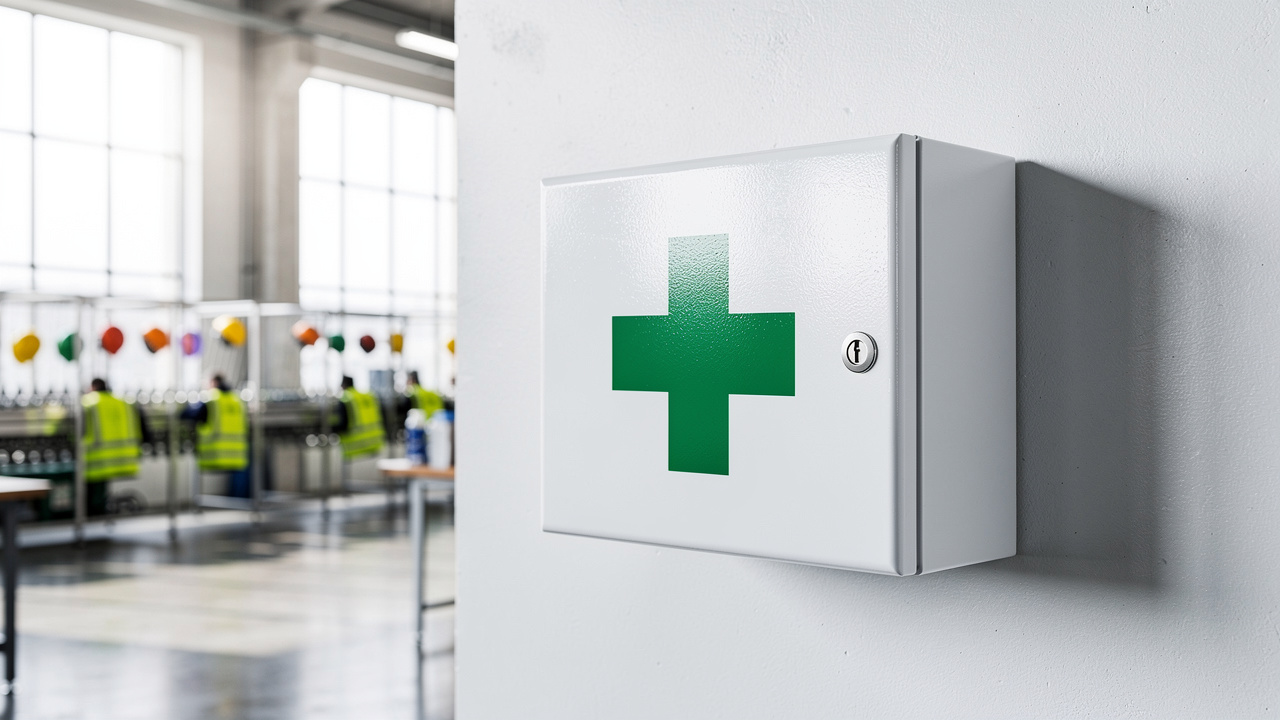
Wherever you mount a kit, aim for a height between about three and five feet from the floor. That keeps it in easy reach for most adults and in clear view over desks or machinery. The front of the kit should have a clear label and the standard first aid symbol with a white cross and green background. Direction arrows or wall signs help new staff and visitors find kits fast.
The storage area should be clean, dry, and away from strong heat, cold, or moisture. Avoid placing kits near ovens, boilers, large south-facing windows, or unheated exterior walls. High heat can weaken glues and liquids, while cold can freeze solutions or crack plastics. As part of your regular safety walks, add a quick access audit to confirm that no one has stacked boxes, tools, or marketing displays in front of first aid stations.
Do not forget people. Add kit locations to site maps, safety posters, and new hire orientation. When everyone knows where kits sit and that they stay stocked, your first aid kit maintenance program turns into a living safety habit, not just a binder on a shelf.
When To Consider Outsourcing Professional First Aid Kit Maintenance Services Vs In-House Management
For some organizations, handling first aid kit maintenance inside the company makes perfect sense. For others, the number of sites, kits, and staff hours needed to keep up with checks can pull focus away from core work. In those cases, outside maintenance services may be worth a close look.
Professional first aid kit maintenance services usually work on a set visit schedule. A trained technician comes to each site, inspects every kit, cleans the container, replaces expired or missing items, and places a dated sticker on the front. After each visit, they provide a report showing what they checked, what they replaced, and the current status of each kit. This gives you a tidy file for audits and internal reviews.
Outsourcing often makes sense when:
You have many sites or a large campus with dozens of kits
Safety staff are stretched thin with other duties
You have a history of missed inspections or frequent expired stock
You want consistent third-party documentation for audits and insurers
Costs often include a flat fee per kit per visit plus the cost of supplies. To judge value, compare that spend to what you now pay in staff time for inspections, ordering, receiving, and stocking, along with any past issues with missed checks or expired stock. For large campuses, multi-site chains, or companies with few safety staff, outside support can free your team to focus on training and hazard reduction.
In-house management fits better when you have a small number of kits in one building, a dedicated safety or facilities person on site, and a low injury rate. In that case, the time needed for weekly checks and monthly inspections may be modest. Some companies use a mix, asking a service to handle quarterly deep inspections while supervisors handle weekly quick checks and same-day post-use restocking.
When you speak with any service provider, ask about their technician training, inspection method, supply brands, report format, and contract terms. Also, ask how they handle rush restocks after large incidents. Remember that even with a service in place, the employer keeps legal responsibility for safety performance. While First Aid Longs focuses on designing and producing high quality medical supplies, the company can help connect you with trusted service partners and can support any maintenance model you choose with steady, reliable products.
Conclusion
A first aid kit is more than a plastic box on a wall. Its real value comes from steady care. Regular first aid kit maintenance keeps every item clean, in date, and ready for that one moment when a worker, visitor, or contractor needs fast help. Without a clear system, even the best kit turns into a dusty box full of question marks.
You have seen how OSHA and ANSI standards set the frame, how a three-tier schedule of weekly checks, monthly inspections, and post-incident restocking keeps kits ready, and how written logs protect your organization during audits or claims. You have also seen how to handle expired supplies, assign clear owners, pick smart storage spots, and weigh in-house care against professional services.
The next steps are clear:
Carry out a simple first aid needs assessment.
Match each area to Class A or Class B kits.
Write your inspection schedule and name responsible people with backups.
Put checklists and logs in place, remove expired items at once, and use refill or replace strategies that keep costs under control.
With quality supplies from First Aid Longs and a steady process, your kits will stand ready when they matter most, and your organization will show real commitment to safety, not just basic compliance.