Workplace burns often look minor, yet knowing when a burn needs a doctor is what protects workers and your business. Confusion about when does a burn need a doctor, the emergency room, or simple first aid often leads to infections, lost time, and bigger claims. Many incidents start with a splash of hot oil, a welding spark, or a chemical drip that people shrug off. In busy kitchens, plants, and gyms, staff may throw on a bandage and go right back to work. A safer approach uses clear red flags. This article explains how depth, size, location, cause, infection signs, and healing problems tell you when to treat on site, when to send staff to a clinic, and when to call 911. You will also see how a supplier like First Aid Longs fits into a practical burn response plan.
By the end, you can turn confusing medical rules into simple playbooks for supervisors, with better protection for people, OSHA compliance, and uptime across every site.
When does a burn need a doctor versus emergency care?

Knowing when a burn needs a doctor instead of only first aid starts with a quick severity check. The same check also tells you when the injury is serious enough for emergency services rather than a clinic visit. For workplace leaders, the safest framework is to look at depth, size, location, cause, and symptoms, then slot each incident into one of three paths.
For small, superficial burns that are smaller than the worker’s palm, not blistered, and away from the face, hands, feet, or joints, on site care and monitoring is usually enough. For deeper or larger burns, burns on critical body areas, slow healing wounds, or any burn in a medically fragile employee, a doctor or occupational health clinic should see the worker the same day. Any burn that looks deep, covers a large area, involves electricity, strong chemicals, or smoke, or comes with breathing trouble or shock belongs in the emergency room with 911 activated.
The three escalation levels you should use on site
The three escalation levels for workplace burns are treat and monitor, see a doctor soon, and emergency now.
Treat and monitor covers small, red, painful burns without large blisters, located away from critical areas, in otherwise healthy workers.
See a doctor soon covers second degree burns with blisters, moderate size injuries, suspected infection, slow healing, and burns in people with diabetes or poor circulation.
Emergency now applies when the skin looks charred, white, brown, or leathery, when the burn is bigger than the worker’s hand, or when the cause is electrical, strong chemical, or a fire in an enclosed space.
Emergency also includes burns with breathing trouble, confusion, or signs of shock such as pale, clammy skin. Teaching supervisors these three buckets keeps decisions simple and leans toward safety and legal protection.
How burn depth, size, and location guide your decision
Burn depth, size, and location give you fast, reliable clues about medical need. According to a medical reference on burn classification, a first degree burn is red, dry, and painful without blisters, while a second degree burn has blisters and moist, very sore skin. A third degree burn looks white, brown, or black, often feels stiff, and may oddly hurt less in the worst area because nerves are damaged.
Size matters because bigger burns lose more fluid and carry more infection risk. A common rule, drawn from guidance used by the American Burn Association and OSHA, is that anything larger than the worker’s palm or roughly 2 to 3 inches across needs a doctor. Location also shifts the bar, since burns on the face, hands, feet, genitals, buttocks, or major joints can limit breathing, vision, or movement if not treated early.
Red flags for when to call 911 or send straight to the ER

Red flags for when to call 911 for a burn focus on appearance, cause, and whole body symptoms. Emergency departments, supported by groups like the American College of Emergency Physicians and major hospital networks, expect employers to move fast once these signs appear. Your written procedures should match these triggers so staff do not pause to debate while damage continues.
If skin looks charred, waxy white, or leathery, or if a burn wraps all the way around an arm, leg, chest, or neck, the situation is an emergency, even when the person says it does not hurt much. Emergency care is also needed when burns are combined with breathing trouble, confusion, or loss of consciousness. Burns caused by electricity, strong industrial chemicals, or any fire or explosion in an enclosed area also need an ambulance, because early airway and heart problems can be subtle.
Deep or very large burns call for 911 when they cover more than the worker’s hand, look charred or white, or form a tight ring around a limb. These injuries threaten circulation and fluid balance, and onsite staff rarely have the training or tools to judge that risk correctly. Sending the worker straight to the emergency department protects both the person and your company.
Burns that follow explosions, warehouse or kitchen fires, or exposure to heavy smoke need emergency care because the airway can swell and breathing can worsen quickly. Even if a worker seems fine at first, signs like hoarseness, coughing soot, singed nasal hair, or headache after smoke exposure are big warnings. Treat these as time sensitive incidents, not something for tomorrow’s clinic visit.
Emergency signs based on how the burn looks and feels
Emergency signs based on the burn’s look and feel usually mean the injury is at least a deep second degree or third degree burn. Skin that appears charred, black, dark brown, waxy white, or dry and leathery instead of moist often signals full thickness damage, a sign covered in the medical encyclopedia entry on burns. Very large burns, especially those larger than the worker’s hand or that wrap around a limb or chest, also fall into this box.
A surprising clue is pain that seems less intense in the worst looking center of the burn than at the edges. That mismatch suggests destroyed nerve endings in the middle, which is common in severe injuries that require surgical care. Because these burns can lead to shock, fluid loss, and severe infection, they skip routine clinic visits and go straight to the emergency room.
Causes that are automatic 911 triggers
Some burn causes are automatic reasons to call 911 because the real damage may be hidden under the skin. Electrical burns from tools, panels, or power lines can disrupt heart rhythm and injure muscles and organs along the current path, even when the entry and exit points look small, a pattern reflected in current adult burn referral guidelines. Lightning strikes on outdoor crews, such as construction or security staff, fit the same pattern and always need hospital care.
Strong chemical burns in workplaces using acids, alkalis, or industrial cleaners also demand fast medical help, especially if pain or tissue damage continues after flushing with water. Burns from flames, fuel explosions, or smoke in enclosed areas like walk in freezers, warehouses, hotel rooms, or vehicles come with inhalation risks. If you see rapid swelling, pale and clammy skin, confusion, or a weak, fast pulse, those shock signs make emergency services the only safe choice.
Severe sunburn and heat exposure on outdoor crews
Severe sunburn and heat exposure on outdoor crews turn into emergencies once whole body symptoms appear. Sunburn linked to fever, vomiting, confusion, fainting, or signs of dehydration such as extreme thirst or very dark urine is more than just bad redness. Workers in construction, agriculture, events, or security who show these signs need urgent care, since heat stroke and severe dehydration can be life threatening within a short time.
When does a burn need a doctor but not the ER?
A burn needs a doctor but not the emergency room when it is more than a simple first degree injury yet does not meet emergency triggers. For employers, this middle ground covers many recordable cases that still allow planned transport to occupational health or urgent care. Getting a timely medical visit in these situations limits complications, improves recovery, and gives better documentation for workers’ compensation and OSHA records.
Second degree burns with blisters wider than a quarter or total width beyond about 2 inches nearly always warrant a same day clinic visit, consistent with findings from a large retrospective analysis of burn patient outcomes. The same is true for any blistered burn on the face, hands, feet, genitals, buttocks, or over a major joint, even if small, because scarring there affects function and appearance. Doctors also should see burns that are slow to close, increasingly painful after the first couple days, or located in workers with diabetes, circulation problems, or weak immune systems.
Signs of an infected burn you can’t ignore
Signs of an infected burn you cannot ignore usually start around the wound edges. Growing redness that spreads outward, increasing warmth, and swelling after the first 2 or 3 days all point toward infection rather than simple irritation. Pus, cloudy drainage, or a bad smell from the wound are strong warnings that bacteria are multiplying.
Red streaks moving away from the burn toward the body, fever, chills, or a worker saying they feel sick or unusually tired make the situation more urgent. In hot kitchens, humid food plants, gyms, or construction sites where dirt and sweat are everywhere, these infections can worsen fast. Any of these signs should trigger a same day visit to a doctor or occupational health clinic.
Burn healing complications that call for medical help
Burn healing problems that call for medical help often appear a week or two after the incident. If a minor looking burn has not clearly improved or closed within about 10 to 14 days, a doctor should review it. Skin that starts to heal then breaks down again, or scars that become thick, raised, and itchy, suggest deeper damage than first thought.
Pain that stays intense or gets worse instead of easing over time is another concern, along with new numbness or tingling near the injury. These symptoms can reflect nerve involvement or early contractures, which are tight scars that limit movement around joints. For workers who rely on fine hand skills, walking, lifting, or reaching, these changes can directly affect job performance and future income.
Special cases high risk workers and tetanus shots
Some workers need medical review for burns that others might safely manage with onsite care. Employees with diabetes, poor circulation, kidney disease, or weakened immune systems from chemotherapy or steroid use face higher risks of infection and slow healing, a risk pattern seen in epidemiological research on extensive burn patients. Even small burns on their feet or lower legs deserve a doctor’s visit, because minor wounds in those areas can become serious ulcers.
Tetanus is another reason to send someone for care. Burns provide an entry point for the bacteria that cause tetanus, especially when the wound is deep or contaminated with dirt, metal, or dust. If the worker’s last tetanus shot was more than 5 years ago, a booster within about 3 days is generally recommended.
When can you treat a burn on site and how to do it safely?

You can treat a burn on site when it is clearly small, superficial, and away from high risk areas like the face or major joints. In these cases, correct first aid and monitoring reduce pain and help the skin heal smoothly while the employee stays at work. Linking your approach to guidance from groups such as the Centers for Disease Control and Prevention and the National Safety Council makes your program easier to defend.
Minor workplace burns are typically first degree, with red, sore skin and no or very small blisters. The affected area is smaller than the injured person’s palm, does not cross flexible areas like fingers or elbows, and comes from a brief contact rather than long exposure. For these cases, your first aid team cools the burn, protects the skin, manages pain, and gives clear instructions about warning signs that mean the worker should come back or see a clinician.
What a minor workplace burn usually looks like
A minor workplace burn usually looks red and feels painful but has no large or numerous blisters. The spot is small, often no bigger than the worker’s fingertip or a few coins, and limited to a flat area like the forearm or back of the hand. The burn is not on the face, eyes, hands, feet, genitals, buttocks, or over a major joint, and there is no circumferential band around a limb.
The worker is otherwise healthy, without diabetes, serious circulation issues, or medicines that slow healing. Pain improves after cooling and over the next day with simple measures like over the counter pain relievers. There are no signs of infection, and the skin starts to look better rather than worse after the first 48 hours.
Step by step first aid that reduces problems later
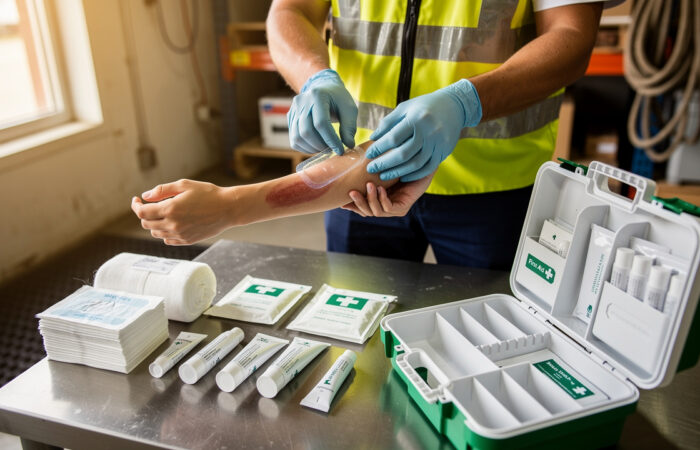
First aid for minor burns should follow a clear, repeatable sequence so every supervisor responds the same way. Staff first stop the burning source, power, or chemical exposure, then cool the skin with cool or lukewarm running water for 10 to 20 minutes instead of using ice. Next they remove rings, watches, and tight clothing near the burn before swelling starts, without pulling off anything stuck to the wound.
After cooling, they gently clean the area with mild soap and water, pat it dry, then cover open or blistered spots with a nonstick dressing and breathable wrap. The injured person elevates the limb when possible and may use acetaminophen or ibuprofen if company medical policy allows and there are no personal health conflicts. Staff also explain what not to do, which includes using butter, oils, toothpaste, egg whites, or fluffy cotton, and remind the worker to report any new redness, drainage, or fever.
Cooling and cleaning come first, because they limit deeper tissue damage and wash away surface contaminants. Running water at a comfortable temperature helps pull heat out of the skin without the blood vessel constriction that ice can cause. This simple step, recommended by emergency nurses and burn centers, is one of the most effective actions onsite teams can take.
Protecting and monitoring the burn comes next, with nonstick dressings that stay clean and dry and short, daily checks of how the area looks and feels. Dressing changes offer chances to spot early infection or healing problems before they become serious. Clear written instructions sent home with the worker help make sure good care continues after the shift ends.
How First Aid Longs products support safer onsite care

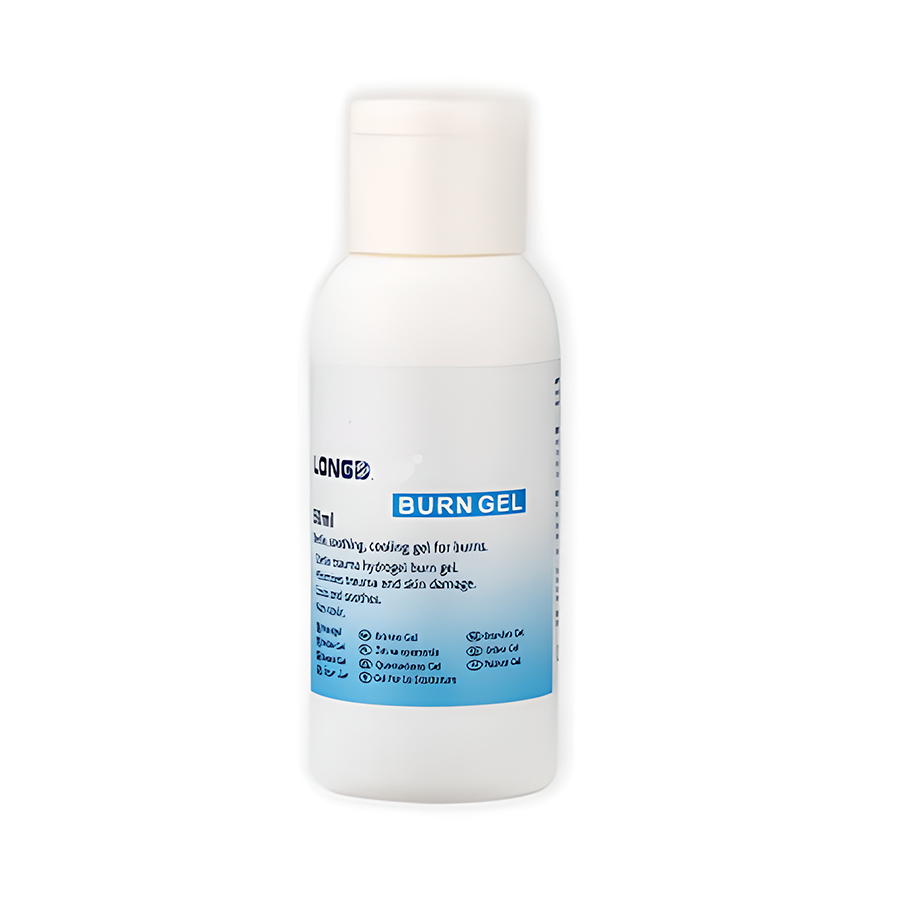
Specialized products make it easier for staff to follow these steps under pressure. Burn gels and hydrogel dressings cool and cover minor burns in one move, which is especially helpful in kitchens, labs, and manufacturing cells where managers juggle many tasks. Tube based burn relief gels near guard desks, reception counters, and small break areas let teams respond to fingertip or small hand burns without hunting for supplies.
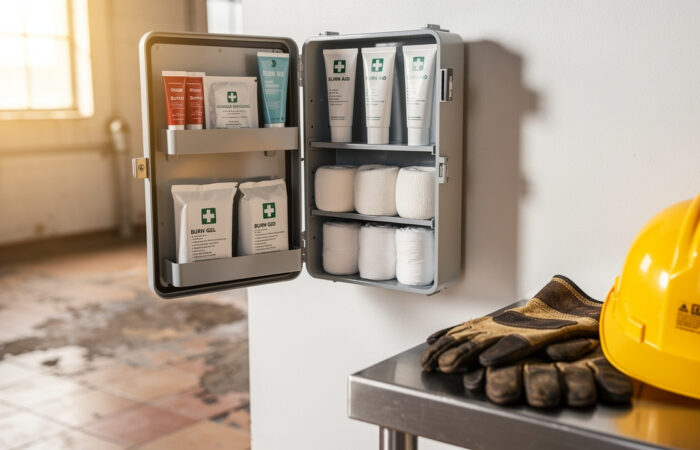
Standardized first aid kits with nonstick gauze, wraps, tape, and eyewash keep equipment consistent across plants, offices, schools, and gyms. The platform works with safety teams to match kit contents and refills to actual burn risks, while also weaving simple escalation rules into labels, posters, and stocking plans. That combination supports quick first aid for minor injuries without blurring the line between workplace care and medical practice.
Operational playbook for embedding burn escalation into your safety program

An operational playbook for burn escalation turns medical rules into simple steps your supervisors can follow under stress. Multi site employers across sectors like manufacturing, logistics, hospitality, and education benefit when every location uses the same decision points and records. Consistent policies also show regulators and insurers that your organization takes worker safety and OSHA recordkeeping seriously.
Your playbook should define exactly when staff treat on site, when they call the occupational health provider, and when they activate 911, using wording that matches public guidance from OSHA and local emergency services. It should also spell out who decides, how to document the incident, and how to review patterns over time, such as repeated fryer burns in the same kitchen. A good playbook ties these rules to real world scenarios from your own sites, which makes training stick.
A strong playbook includes simple charts or pocket cards that walk supervisors from the first question to the final decision. For example, a flow chart might start with the burn’s size and location, then ask about blisters, cause, and symptoms like trouble breathing or numbness. Posting these tools near first aid stations and control rooms keeps them easy to find in the moment.
The playbook also links to training schedules, incident forms, and supply standards so the process does not depend on memory alone. During annual drills, leaders can test whether staff follow the chart correctly in mock events like chemical splashes or welding flashes. These exercises reveal gaps in both understanding and stocking before a real emergency occurs.
Simple decision tools for non medical supervisors
Simple decision tools help non medical supervisors make safe choices without needing clinical training. Rules such as bigger than the worker’s hand or on the face, hands, feet, genitals, buttocks, or a major joint means doctor or emergency room give clear direction. Another rule says any burn from electricity, lightning, strong acid or alkali, or smoke in an enclosed space is an automatic emergency.
Supervisors can also remember that growing redness, pus, or a foul smell from a burn always means a same day clinic visit. If a manager ever feels unsure whether a burn is minor or not, the policy should advise choosing medical evaluation rather than waiting. These tools reduce hesitation and make responses more consistent across shifts and locations.
Training, documentation, and standardized supplies
Training, documentation, and standardized supplies hold your burn escalation system together over time. Scenario based drills for events like kitchen scalds, welding flashes, or chemical splashes help staff apply written rules to real work situations. Incident forms that capture cause, body part, estimated size, first aid steps, and escalation choice support OSHA compliance and workers’ compensation reviews.
Standardized kits, restock packs, and posted burn response guides from the tool make it easier to keep every site ready, whether it is a warehouse, hotel, school, or gym. Using the same components across locations helps safety leaders compare incidents and spot patterns, such as frequent burns at one machine or shift. Over time, these insights point to engineering, training, or staffing changes that reduce burn risk at the source.
Summary and next steps
Burns at work range from brief contact burns that heal quickly to deep, life changing injuries, so your escalation rules need to be clear. Depth, size, location, cause, and symptoms tell you whether to manage a burn at the first aid station, send the worker to a doctor, or call 911. Watching for infection signs and healing problems keeps apparently small burns from turning into long term issues.
A strong burn playbook protects both people and operations. It pairs simple rules for when a burn needs a doctor with training, documentation, and supplies that make those rules easy to follow during a busy shift. When you update your first aid kits and burn protocols, consider working with First Aid Longs to align gels, dressings, and OSHA friendly kits with the escalation triggers described here.
Secure Reliable Burn Gel Supplies Today!
Order our high-quality wholesale burn gels made with safety standards to stabilize your healthcare operations.