Eyewash station placement keeps workers protected and keeps you aligned with clear safety rules. Poor placement turns expensive gear into something no one can reach in time when seconds matter. Under OSHA 29 CFR 1910.151(c) and ANSI Z358.1, you must put each eyewash station close enough and mount it the right way. This guide explains when stations are required, how far they can be, how high to mount them, and how First Aid Longs products fit compliant layouts across your sites.
You will see examples from US hospitals, factories, and construction sites so you can apply the same logic across your own buildings and keep your people safe.
Where Is Eyewash Station Placement Required By OSHA And ANSI

Eyewash station placement is required anywhere workers can be exposed to injurious corrosive materials during normal tasks. OSHA sets this trigger, and ANSI Z358.1 explains how the emergency gear should operate and where it should be located.
OSHA 29 CFR 1910.151(c) focuses on exposure, not just the fact that a chemical drum sits in a room. Safety Data Sheets and task reviews tell you where corrosives can actually reach someone’s eyes. ANSI then fills in details like distance, height, flow, and water temperature so your eyewash station meets good practice in the United States, with Biosafety Guidelines – StatPearls offering further context on biohazard safety frameworks that overlap with these requirements.
According to NIOSH, about 2,000 US workers need medical treatment for job related eye injuries every day, which shows how important correct eyewash station placement is for you.
Typical Work Areas That Trigger Eyewash Station Placement
Typical work areas that trigger eyewash station placement share one feature, which is realistic splash or spray risk near the face. You look for corrosive chemicals first, then for very strong irritants that can still damage eyes. ANSI Z358.1 uses the wider idea of hazardous materials, so many programs choose to provide a nearby eyewash station even when OSHA would not strictly require one.
- Hospital sterile processing, endoscopy rooms, environmental services closets, and clinical labs often use high level disinfectants and caustic cleaners. So the chance of splashes is real. An eyewash station in the same workroom keeps response time short for your team.
- Industrial mixing rooms, battery charging areas, plating lines, and boiler or HVAC chemical treatment rooms handle acids and alkalis in bulk. These rooms usually need at least one plumbed eyewash station nearby.
- Construction chemical mixing stations, concrete and epoxy work zones, and fuel treatment areas expose crews to cement dust, additives, and resins. Portable eyewash station units help you protect workers even when plumbing is not in place yet.
- School and university labs, maintenance shops, and pool chemical rooms handle acids, bases, and strong cleaners around students and staff, and research on Boosting Safety Protocol Compliance shows how eye tracking and observational studies in chemical environments reinforce the need for well positioned emergency fixtures.
You can summarize common zones like this.
| Area Type | Typical Hazard | Eyewash Station Recommendation |
|---|---|---|
| Healthcare decontam room | Corrosive detergents and disinfectants | Plumbed eyewash station in the same room near sinks |
| Battery charging room | Battery acid and off gassing | Combination eyewash and shower close to charging racks |
| Custodial closet | Cleaning concentrates for dilution | Wall mounted or compact bottled unit by the sink |
| Student lab | Acids, bases, and solvents | Plumbed eyewash at lab sink or just outside lab door |
| Construction mixing station | Cement, epoxy, fuel additives | Portable self contained eyewash within the work zone |
As you identify these rooms, your next step is to decide how close each unit must be to the task. You can also connect this hazard review with your broader workplace safety pillar content so users can jump to related topics like chemical handling and PPE.
How Close Should An Eyewash Station Be To The Hazard

Eyewash station placement must keep units close enough that a hurt worker reaches water in about 10 seconds. ANSI converts that into a walking distance of roughly 55 feet along a clear path on the same level as the hazard.
This rule applies across hospitals, factories, construction sites, and schools in the United States. If chemicals are stronger, you move the eyewash station even closer, sometimes right beside the process. OSHA looks at this 10 second idea when judging whether your layout counts as “immediate emergency use” during inspections.
Applying The 10 Second Rule And Access Requirements
Applying the 10 second rule starts with walking the same route a panicked worker would use. You measure the real travel path, not the straight line on a floor plan. Stairs, ladders, and sharp elevation changes do not count as acceptable routes, so the eyewash station must sit on the same floor.
The path must also be clear. Workers should not fight locked doors, turnstiles, pallets, carts, or hoses when they cannot see an issue supported by An Experiment on the impact of signage and wayfinding on emergency response times in built environments, which highlights how unobstructed, well marked paths significantly reduce the time it takes to reach safety equipment. Timed drills or quick test walks help you confirm that each route fits the 10 second goal and highlight spots where storing pallets or carts would block access.
You can use a simple check like this.
| Scenario | Current Distance | Compliant | Suggested Fix |
|---|---|---|---|
| Lab using acids with eyewash in hallway past a door | 70 feet | No | Add bench mounted eyewash station at the lab sink |
| Battery room served by combination unit across corridor | 80 feet | No | Install a new unit inside the room near the charging racks |
| Construction mix area with portable unit 15 feet away | 15 feet | Yes | Keep unit on same level and protect it from being blocked |
What Are The Height And Clearance Rules For Eyewash Station Placement
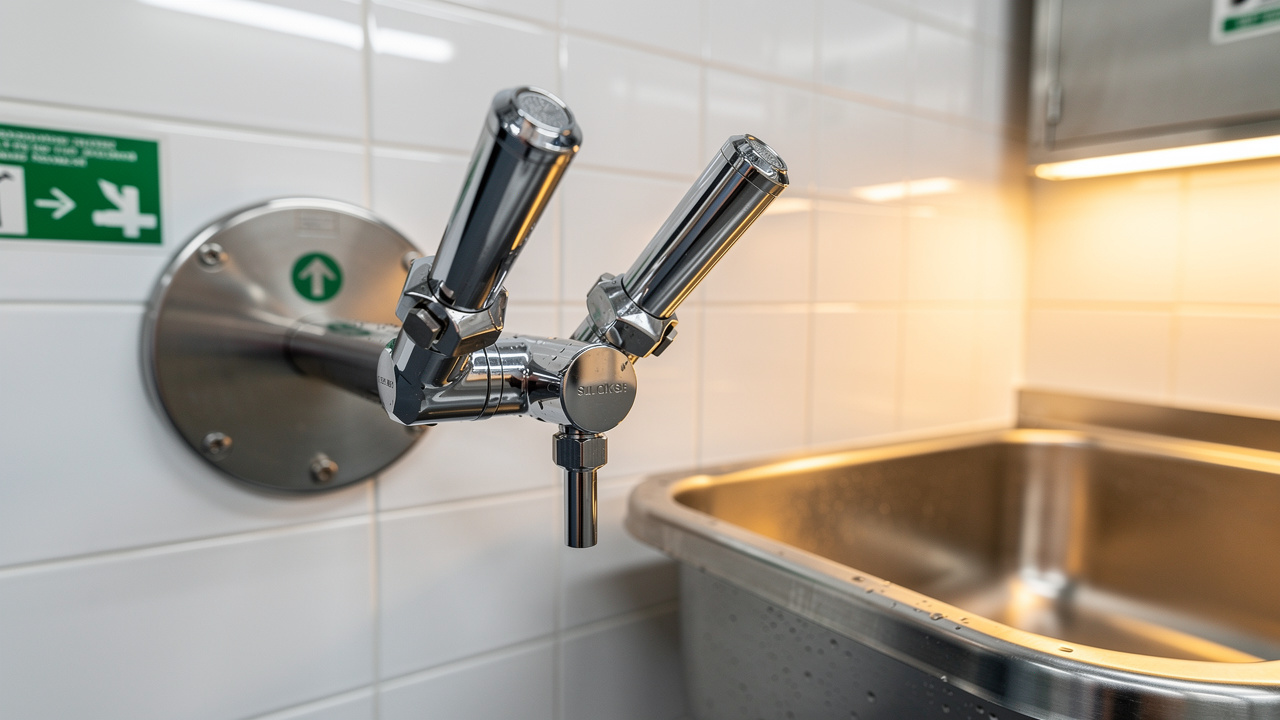
Height and clearance rules make sure your eyewash station placement is usable for workers of different sizes. ANSI Z358.1 sets a spray height between 33 and 53 inches from the floor, with at least 6 inches of space from any wall or obstruction.
These numbers keep the water where the eyes sit without forcing someone to crouch or stand on tiptoe. They also leave enough room for a helper to guide the injured person into the stream. ANSI also calls for at least 0.4 gallons per minute of flow for 15 minutes, or about 3 gallons per minute for eye and face units, so your plumbing design has to match your locations, a consideration that aligns with Analytical Framework Development for industrial standardization, which underscores how water management system design must follow structured, guideline driven approaches in regulated environments.
Positioning Eyewash Stations For Safe, Effective Use

Positioning each eyewash station begins with the 33 to 53 inch height band. When you keep the spray in this window, most workers can lean forward and get both eyes in the water without strain, which supports the full 15 minute rinse that doctors recommend. Units mounted too high often cause splashing and wet floors, while low units are harder to use.
You also keep at least 6 inches of side clearance from walls, cabinets, and machines. That gap gives room for shoulders and hands while a worker holds eyelids open. Where face exposure is likely, you pick an eye and face wash that delivers about 3 gallons per minute over a wider pattern instead of a simple twin jet. Both eyewash and eye and face wash units must hold flow for a full 15 minutes.
Spray heads need covers that keep dust and splashes off but flip open by water pressure when someone activates the valve. Avoid suspending units directly under dusty ductwork or heavy overspray, which can foul heads between weekly tests and make your eyewash station placement less reliable.
A short installation checklist can help your maintenance team keep each eyewash station user friendly.
- Confirm spray height sits between 33 and 53 inches when the unit is running. Test with workers of different heights and adjust as needed.
- Check that the spray point is at least 6 inches from nearby walls or equipment. Stand in the stream position and see whether your shoulders hit anything. If they do, move the unit or rearrange nearby gear.
- Measure flow with a simple container and timer to confirm at least 0.4 gallons per minute for eyewash or about 3 gallons per minute for eye and face wash.
- Activate the unit and watch the spray pattern reach both eyes at once without shooting more than about 8 inches above the heads.
How Do Visibility, Environment, and Maintenance Affect Eyewash Station Placement
Eyewash station placement must also account for how easily you can see, test, and maintain each unit. Even a perfectly located station fails if workers cannot find it quickly or if weekly testing is too hard to perform.
ANSI Z358.1 calls for clear identification and good lighting around emergency fixtures. According to Statista, contact with harmful substances and environments remains a leading source of nonfatal workplace injuries, so ongoing attention to emergency gear really matters for you.
Designing Eyewash Locations For Real World Use And Upkeep

Designing eyewash station placement starts with visibility. Each unit should carry bright green and white signs that you can see from across the room, with arrows along long corridors or production lines. Overhead signs help in crowded hospital wings or warehouse aisles, where wall signs may be hidden by carts or racks.
Environment matters, too. Outdoor or unheated areas may drop below freezing, which can stop a plumbed eyewash station from working, so you either use heated enclosures or move the unit indoors. In dusty or high overspray zones, you may pick enclosed or covered designs and avoid placing units over sensitive electronics or sterile storage, a principle reinforced by Risk assessment-based particle sensor location optimization research, which demonstrates how airborne particulate distribution must inform the positioning of safety critical equipment in non-unidirectional environments. Drainage is another key point because a full 15 minute flush sends many gallons of water onto the floor.
Maintenance and inspections should fit easily into the way your people work. Weekly activation flows stale water out of lines and proves that valves and covers still work, while a yearly review checks distance, lighting, and obstructions. When processes, chemicals, or walls change, you update your hazard map and confirm that every corrosive task still has an eyewash station within 10 seconds on the same level.
How Can First Aid Longs Support Your Eyewash Station Placement Plan
First Aid Longs supports your eyewash station placement plan by offering many station types that match different rooms, hazards, and layouts. Because the company manufactures in house with 100K Class cleanroom facilities, you can standardize across sites and still meet local needs.
Since 1996, First Aid Longs has supplied hospitals, factories, construction firms, and schools with wall mounted, portable, and combination eyewash station units. The team backs this with OEM and ODM services, low minimum order quantities, and strong quality control so your purchases line up with OSHA and ANSI expectations. That mix fits buyers who manage large portfolios and who want consistent gear in every US location.
Matching First Aid Long Eyewash Stations To Your Layout

Matching First Aid Longs eyewash station models to your layout starts with fixed high hazard rooms. You can mount them right beside sinks or work benches to hit the 10 second rule and keep eyewash station placement simple for your staff.
Portable eyewash station units from First Aid Longs fit construction sites, remote maintenance areas, or temporary production lines where plumbing changes are not realistic yet. As long as you place them within 10 seconds of the hazard and protect them from freezing or extreme heat, they can meet ANSI flow and duration needs. For high risk corrosive areas, combination stations that include both an eyewash and a full body shower offer a single response point for serious exposures.
Compact boxed eyewash station kits with two saline bottles and 100 ml bottle stations with five small bottles help you add coverage at tight workstations. They are handy in control rooms, small clinic rooms, and low hazard labs where a plumbed unit may be more than you need, but quick eye rinsing is still smart. As a wholesale partner serving more than 100 global clients, First Aid Longs can also set up replenishment programs so saline bottles and parts stay in date across every site.
You can explore the full eyewash station product line from First Aid Longs on the dedicated eyewash page at First Aid Longs.
Conclusion
Now you can look at eyewash station placement as a clear set of steps instead of a mystery. You map corrosive and hazardous tasks, apply the 10 second same level rule, and choose locations with the right height, clearance, lighting, and drainage. From there, you confirm that weekly testing and yearly reviews are realistic at every eyewash station. If you spot gaps, you adjust layouts or add new plumbed or portable units until every worker can reach help quickly. When you are ready to standardize equipment or update multiple sites, you can contact First Aid Longs to talk through product choices, customization, and wholesale support for your next eyewash station placement project.