Trying to untangle regional workplace first aid kit requirements in the UK can feel confusing and risky. Many buyers see different kit labels, HSE guidance, and British Standards, and it is hard to know what really counts as compliant.
Under UK law, regional workplace first aid kit requirements in the UK are based on adequate and appropriate provision, not a fixed contents list. The Health and Safety (First-Aid) Regulations 1981 and Health and Safety Executive (HSE) guidance expect every employer to assess risks, then provide kits, facilities, and people that match those risks. In this article, you will see how the law works, how a first aid needs assessment shapes kit choices, what kits should and should not hold, how many kits each site needs, and how to keep everything aligned across multiple UK regions.
If your role covers several sites or you buy for UK customers, you also need supplier support that matches this needs-based model. Manufacturers such as First Aid Longs build hazard-based product lines that can plug straight into UK-style assessments. Keep reading to see how to turn complex rules into clear, repeatable standards across all your UK workplaces.
How UK laws define workplace first aid kit requirements

UK laws set workplace first aid kit requirements by requiring adequate and appropriate first aid at every site. The law does not fix a single kit list, but it does expect at least one suitably stocked kit in every workplace. This section explains how the Health and Safety (First-Aid) Regulations 1981 and HSE guidance shape regional workplace first aid kit requirements in the UK across all sectors.
Core UK legal framework for first aid kits
The Health and Safety (First-Aid) Regulations 1981, enforced by the Health and Safety Executive, apply to all UK employers and the self‑employed. They cover offices, factories, hospitals, schools, construction sites, and any other place where people work. The duty to provide adequate and appropriate equipment, facilities and personnel means you must match first aid to your real risks, headcount, and work patterns. In practice, that always includes at least one suitably stocked workplace first aid kit for each site, with more where risks or size justify it. If regulators find serious gaps, businesses can face large fines, prosecution, and serious damage to staff trust.
For practical compliance, most organizations:
Carry out a written first aid needs assessment.
Choose kit types and sizes that line up with the assessment.
Train enough first aiders or appointed persons.
Keep records of checks, incidents, and any changes made to provision.
Regional consistency across England, Scotland, Wales, and Northern Ireland
Across England, Scotland, Wales, and Northern Ireland, regional workplace first aid kit requirements in the UK stay largely the same. The same core regulations apply, and HSE or local authorities expect a documented first aid needs assessment in every nation. Local differences mainly affect how rules are enforced and how information is shared, not what must sit inside a box.
For example:
Workplaces in Wales often provide first aid notices in both English and Welsh.
Very rural Scottish or Welsh sites may need extra kits because ambulance response can take longer.
Large city-center locations might place extra kits near reception areas where public footfall is high.
For procurement teams, regional usually means different site types, layouts, and hazards, rather than different laws. Standardizing your internal expectations, while allowing for small site-specific tweaks, helps keep compliance consistent.
How a first aid needs assessment shapes regional kit requirements

A first aid needs assessment is the main tool that turns UK legal duties into clear kit requirements for each workplace. It looks at hazards, people, and locations, then sets out what first aid kits, equipment, and trained staff each site needs. Strong assessments give you a repeatable way to manage regional workplace first aid kit requirements in the UK across offices, factories, fleets, and remote teams.
A structured assessment typically covers:
What could go wrong at this site.
Who might be injured or fall ill.
How quickly outside help could arrive.
What first aid resources are already available.
Key factors to assess at each UK workplace
A good assessment starts with hazard level and type at each site. Low‑risk offices and call centers mainly see cuts, slips, and minor medical events, while manufacturing plants, construction sites, warehouses, kitchens, and labs face higher risks such as heavy bleeding, burns, and chemical splashes. You then look at headcount per shift, lone workers, age profile, and any known health issues that might affect emergency needs.
Work patterns and geography also matter. Multi‑floor buildings, spread‑out campuses, and remote or rural sites usually need more kits so staff can reach them fast. Places that serve the public, such as hospitals, clinics, schools, and retail spaces, should factor in likely incidents involving visitors as well as employees. Longer travel times to hospital or slower ambulance response can justify extra kit contents or additional kits, even for the same basic hazard level.
To make this easier, many health and safety teams:
Map work areas and mark likely incident hot spots.
Note shift patterns and headcount per floor or zone.
Record distances and obstacles between people and the nearest kit.
Capture local emergency response information, such as nearest A&E.
Turning your assessment into kit specifications
Once you understand risks, you can turn them into written kit standards that support regional workplace first aid kit requirements in the UK. Many organizations define several kit types, such as low‑hazard office kits, high‑risk production kits, vehicle kits, and lone‑worker pouches. British Standard BS 8599‑1 for workplaces and BS 8599‑2 for vehicles give helpful benchmark contents for these types, although you still keep final control through your assessment.
You then decide where you need specialist items such as burns kits, eyewash, trauma dressings, or separate biohazard spill kits for body fluid clean‑up. One corporate standard might say that every UK office uses the same BS 8599‑1 small kit, while large plants add an extra burns kit and extra trauma dressings at each production line. Documenting both the assessment and kit rationale helps during audits, incident reviews, and conversations with suppliers such as the platform.
A simple way to document kit standards is to:
Name each kit type and link it to a risk band.
List required contents, quantities, and storage requirements.
Specify where each kit type should be placed.
Record who is responsible for checks and restocking.
What should and should not be in a UK workplace first aid kit

Regional workplace first aid kit requirements in the UK focus on kit contents that treat likely injuries without turning the kit into a drug cabinet. HSE publishes non‑binding guidance for low‑hazard workplaces, and British Standard BS 8599 expands this into structured kit sizes. At the same time, standard UK practice is to keep medicines out of general workplace kits and manage any on‑site medication through separate policies.
Recommended core contents for low-hazard UK workplaces
For offices and other low‑hazard areas, HSE suggests a simple baseline. Each kit should hold a basic first aid guidance leaflet, assorted sterile adhesive plasters, and medium and large sterile unmedicated wound dressings. These cover the most common minor cuts, scrapes, and small wounds.
Bandaging items then add support and flexibility. Sterile triangular bandages help create slings or padding, while safety pins and, where helpful, adhesive tape keep dressings secure. For eye and barrier protection, kits should hold sterile eye pads, several pairs of disposable nitrile gloves, and a CPR face shield or pocket mask. Helpful extras include alcohol‑free cleansing wipes, a foil thermal blanket for shock, and blister plasters where staff walk long distances or stand for long shifts. Quantities scale with staff numbers, incident history, and your assessment.
To keep low‑hazard kits practical and user‑friendly, many employers also:
Choose boxes with clear internal compartments.
Add simple content lists to the inside of the lid.
Place quick instructions near the kit for untrained staff.
Additional contents for higher-risk and sector-specific settings
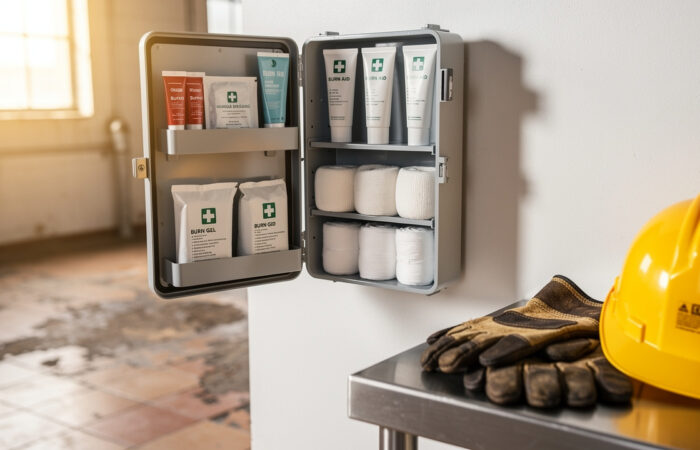
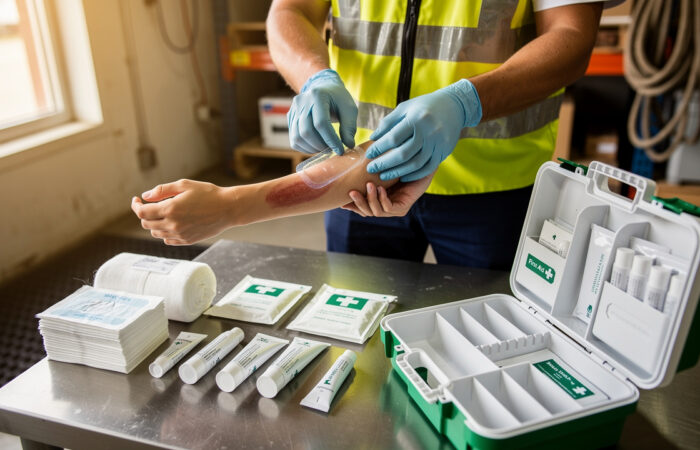
Higher‑risk sites usually need more than the low‑hazard baseline. Manufacturing and construction often require extra medium and large sterile dressings, larger trauma dressings for severe bleeding, and more triangular bandages to support limbs. Kitchens, foundries, and laboratories benefit from dedicated burn dressings, burn gel products, and non‑adherent dressings that protect burned skin.
Where chemicals are present, supplies such as eyewash bottles or fixed eyewash stations and suitable skin irrigation fluids become important. Outdoor and construction teams often need extra foil blankets, strong scissors for cutting clothing or personal protective equipment, and weather‑resistant boxes that protect kit contents from dust and rain. BS 8599‑1 higher‑risk kit sizes provide a strong starting point, which you can then adjust through your needs assessment.
Sector-specific examples include:
Schools: extra plasters, bandages, and child-friendly sizes.
Food production and catering: blue detectable plasters and gloves.
Healthcare: higher volumes of dressings and eye care products.
Transport fleets: compact BS 8599‑2 vehicle kits in every cab.
Items that do not belong in UK workplace first aid kits
Good practice across the UK is clear that general workplace kits should not contain tablets or other oral medicines. That includes everyday painkillers, cold remedies, and antihistamines, as well as prescription drugs such as inhalers, insulin, and adrenaline auto‑injectors. If your organization chooses to make aspirin available for suspected heart attack, it should sit under a clear, separate policy, not in the standard kit. In schools and childcare, named children’s medicines stay in controlled storage and never in open workplace kits.
Other items that can cause problems if stored in general kits include:
Products past their expiry date or without clear labelling.
Items that staff are not trained to use safely.
Non-sterile tools that could increase infection risk.
To highlight how kit content changes by risk level, the following table gives a simple comparison.
| Kit type | Typical setting | Main content focus |
|---|---|---|
| Low‑hazard workplace | Offices, call centers | Plasters, basic dressings, guidance, gloves |
| Higher‑risk workplace | Manufacturing, construction | Larger dressings, trauma pads, burns items |
| Vehicle or lone‑worker | Drivers, field technicians | Compact mix for self‑care during incidents |
How many first aid kits you need, where to place them, and who maintains them

Regional workplace first aid kit requirements in the UK link closely to how many kits you provide, where you place them, and how you keep them stocked. Law and guidance focus on fast access, clear information, and reliable maintenance rather than a single one kit per building rule. This section explains practical planning for multi‑site operations.
Number and placement of kits in multi-site UK operations
You decide kit numbers by looking at risk level, headcount, and layout rather than a fixed ratio alone. A small low‑risk office might manage with one BS 8599‑1 small kit, while a large warehouse with several hundred staff may need a kit in each work zone and kit coverage on every floor. Remote teams, site vehicles, and lone workers such as drivers or field technicians usually need dedicated vehicle or personal kits that match their tasks.
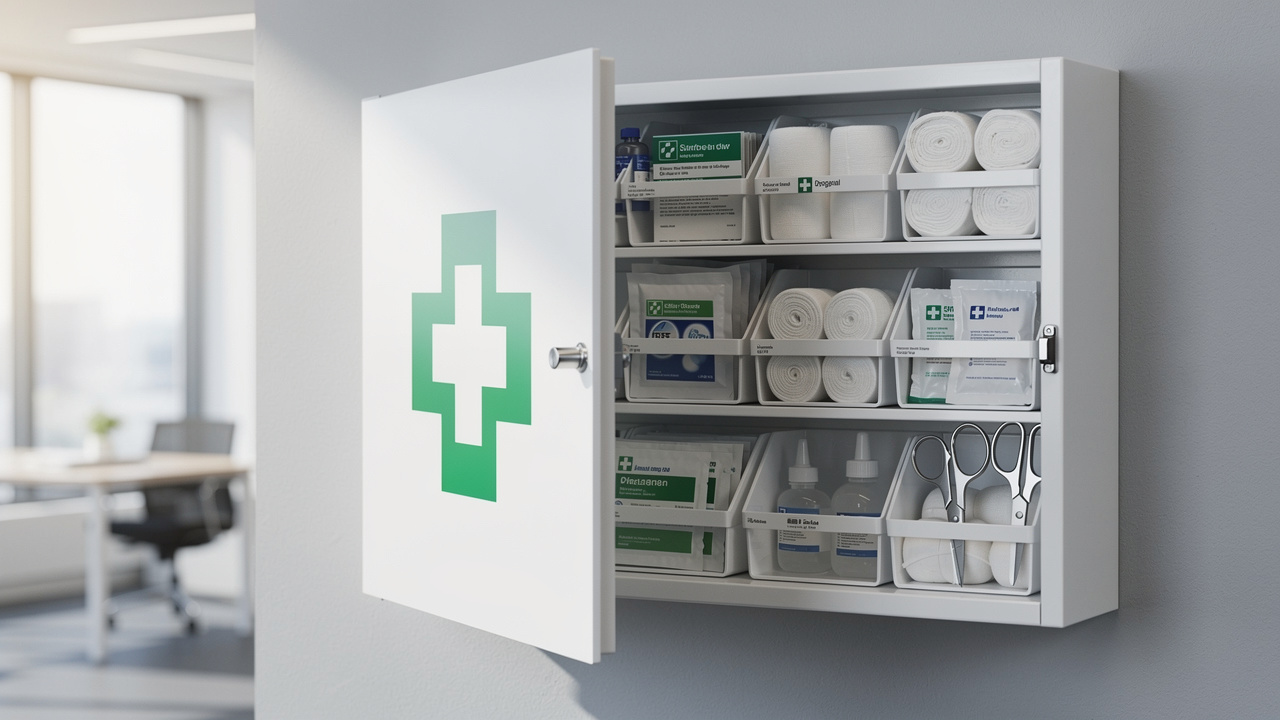
Placement rules aim for speed and clarity. Kits should be easy to see, clearly marked with the white cross on a green background, and mounted or stored where people can reach them within a few minutes. Many organizations mark kit and automated external defibrillator (AED) locations on floor plans or digital maps so new starters and visitors can find them fast. Applying the same internal standard in England, Scotland, Wales, and Northern Ireland keeps regional provision consistent even when buildings differ.
Helpful placement practices include:
Keeping kits in fixed, signed locations rather than locked drawers.
Avoiding storage near extreme heat, damp, or heavy dust.
Pairing kits with a list of local first aiders and emergency numbers.
Responsibilities, inspections, and expiry control
Someone must own each kit. UK rules talk about an appointed person who looks after equipment and calls emergency services, and a first aider who holds Emergency First Aid at Work or First Aid at Work training. For day‑to‑day control, many organizations assign each kit to a specific first aider or local manager who checks it on a set schedule. High‑use areas may need checks every month, while very quiet offices might work on a quarterly plan.
During each check, the kit owner looks for missing items, damaged packaging, broken seals, and expired sterile products. Simple paper or digital logs record the date, name of the checker, and any items replaced, which helps during audits and incident reviews. When a serious incident, new hazard, site move, or major refurb takes place, you can use that as a trigger to review kit specifications and wider regional workplace first aid kit requirements in the UK.
For larger organizations, it often helps to:
Use standardized checklists for every kit type.
Set automatic reminders for inspection dates.
Analyse usage patterns to adjust kit sizes and contents over time.
How First Aid Longs supports UK-regional workplace first aid kit compliance

Turning legal duties and risk assessments into ready‑to‑deploy kits can feel hard, especially when you manage many UK sites from a central office. Regional workplace first aid kit requirements in the UK also change by hazard type, so you need flexible product lines as well as clear rules. This is where a specialist manufacturer and wholesaler can help.
Customizable kits and scalable replenishment for multi-site UK workplaces
First Aid Longs is a long‑standing in‑house manufacturer of workplace and industry‑specific first aid kits, eyewash, burn care, and related consumables. Its cleanroom production and quality systems support healthcare clients, factories, schools, and many other sectors that need high trust in their supplies. Because production sits in‑house, the company can adjust kit contents, sizes, and containers to match your written standards for offices, plants, construction sites, laboratories, or educational campuses.
Many buyers use empty boxes plus pre‑packed component sets to build kits that line up with HSE guidance and BS 8599 profiles. That approach lets you keep one regional workplace first aid kit requirements document for the UK, then build several kit types directly from it. Refill and replenishment programs help large organizations keep dozens or hundreds of kits consistent across regions, without staff needing to pick items one by one. With bulk and wholesale supply, flexible minimum order quantities, and OEM or private label options, the tool can support central US or global procurement teams that need UK‑specific product lines.
Typical support from the platform can include:
Advising on kit configurations for different hazard bands.
Creating custom labels that match your internal naming.
Supplying refills in simple, pre-sorted packs.
Helping you align physical products with your written policies.
Secure Reliable First Aid Kit Supplies Today!
Explore our first aid kits designed to reduce delays and stabilize your healthcare operations.
In summary
UK workplace first aid kit rules rest on law plus a site‑specific needs assessment rather than a single fixed contents list. HSE guidance, British Standard BS 8599‑1 for workplaces, and BS 8599‑2 for vehicles give helpful reference points, but your own assessment still sets final requirements at each site.
When you apply the same assessment method across England, Scotland, Wales, and Northern Ireland, you get a clear regional standard that works for offices, factories, vehicles, and remote workers. Strong maintenance routines, clear roles for appointed persons and first aiders, and good records keep those kits ready for real incidents. With a partner such as First Aid Longs, you can turn your written regional workplace first aid kit requirements in the UK into consistent, scalable, and cost‑effective kit programs.