Workplace injuries cost US employers more than $170 billion every year, and the Bureau of Labor Statistics counts roughly 2.5 million nonfatal cases across American workplaces annually, a figure confirmed in a recent employer-reported workplace injuries report. Every one of those incidents depends on a first aid kit that actually performs the moment someone reaches for it. That reality is pushing more healthcare procurement managers, safety officers, and corporate health coordinators to ask one blunt question before signing a purchase order: is this really a CE certified first aid manufacturer in the UK, or just a product listing with a logo pasted on?
A CE certified first aid manufacturer in the UK has passed independent conformity checks confirming its products meet European safety and performance rules. First Aid Longs, a manufacturer and wholesale supplier operating since 1996, builds its entire catalog around that standard. This guide explains what CE certification actually verifies, why manufacturer origin changes your risk exposure, which warning signs point to an unverified overseas supplier, and how to check any manufacturer before committing your budget. Read through before your next purchase order goes out.
Key Takeaways
Procurement teams juggling dozens of vendor conversations rarely have time to re-read a full buyer’s guide, so here’s the short version before the detailed breakdown below.
CE certification verifies that a manufacturer passed conformity assessment and technical documentation review under EU medical device rules.
Unverified overseas manufacturers, including many unverified Chinese-origin listings, often carry no traceable ISO audit history or UK distribution footprint.
Buyers should always request certificate numbers, audit records, and third-party lab test reports before ordering.
In-house manufacturing lowers quality and delivery risk compared to outsourced, multi-vendor production chains.
A short list of direct questions before signing a supply contract protects your budget and your compliance record.
What Does CE Certification Actually Mean For First Aid Manufacturers?
CE certification is a manufacturer’s formal declaration, backed by independent review, that its products meet essential safety and performance rules set out under EU Medical Device Regulations. For a genuine CE certified first aid manufacturer in the UK, earning that mark means submitting technical documentation, undergoing a conformity assessment, and proving a working quality management system, not simply printing four letters on a box. The process also sorts products into risk classes that determine how much scrutiny a manufacturer faces. A basic plaster or sterile gauze pad typically sits in Class I, the lowest risk tier, where a manufacturer can self-declare conformity under a documented quality system. A public access defibrillator sits far higher on the risk scale, so it requires review by an independent notified body, more extensive clinical and performance data, and ongoing surveillance after the product reaches the market. Understanding this tiered system helps a buyer judge whether a supplier’s certification claim actually matches the complexity of what they’re selling.
CE Vs. UKCA: What Buyers Need To Verify
UKCA marking is the UK’s own conformity mark, introduced after Brexit as the domestic counterpart to the European CE system. Buyers sourcing first aid supplies should check documentation for both marks, since CE confirms EU market compliance while UKCA confirms UK compliance, and many manufacturers now carry both to serve both markets at once. For American buyers, there’s one more step worth remembering. CE marking on its own doesn’t equal FDA approval, so any product entering US facilities still needs its own separate FDA compliance check.
Why Does Manufacturer Origin Matter For Quality And Trust?

Manufacturer origin matters because a real CE certified first aid manufacturer in the UK operates under audit trails, named distribution partners, and test records that a buyer can actually verify, while plenty of online listings cannot offer any of that. Search results for first aid kit wholesale suppliers are full of products described as CE certified that trace back to unverified overseas factories, many based in China, with no public ISO audit history, no named UK distribution partner, and no independent lab report a buyer can request, a gap that a broader workplace injuries by industry analysis suggests makes sourcing verification even more critical for high-risk sectors. That gap matters because a sterile wound dressing or burn gel that fails during an actual emergency isn’t a minor service complaint, it’s a patient safety event and a potential liability claim sitting on your organization’s books.
Before signing any supply contract, ask the manufacturer for:
Its CE certificate number and the name of the notified body that issued it, since a legitimate supplier will hand this over without hesitation.
ISO 13485 audit records, the international quality management standard built specifically for medical device manufacturing.
The names of any UK distribution partners they work with.
Copies of recent third-party lab test reports.
A manufacturer that hesitates, stalls, or can’t produce any of these four items in writing is telling you something important about how they actually operate.
Red Flags That Signal An Unverified Supplier

Spotting an unverified supplier early saves procurement teams from costly contract reversals down the line, and most warning signs show up well before a single box ships. Watch for vague or missing certificate numbers, since a genuine manufacturer can always produce one on request along with the issuing body’s name.
The following list covers the most common red flags buyers run into during vendor screening.
No named notified body or documented audit trail backing up certification claims.
Frequent backorders paired with lead times that keep shifting after the order is confirmed.
Pricing that looks simple at quote time but grows with unclear add-on fees later.
Product specifications that change between orders without any prior notice to the buyer.
No quality testing results available when a buyer asks for them directly.
How First Aid Longs Delivers Verified, CE Certified Manufacturing

First Aid Longs operates as a CE certified first aid manufacturer in the UK with an in-house production model built over nearly three decades, giving procurement teams a clear, verifiable alternative to unverified overseas sourcing. The company has manufactured and supplied first aid kits and medical consumables since 1996, and that long operating history means its sterilization protocols, material sourcing, and quality control sit under one roof rather than scattered across subcontracted factories. Keeping design, production, and quality checks within a single facility shortens lead times, tightens accountability, and lets the company catch issues before a product ever reaches a customer’s loading dock, rather than after a complaint comes in.
Every product line undergoes durability and shelf-life testing designed to confirm performance holds up under heat, humidity, and the kind of rough handling first aid supplies actually face in warehouses and job sites. The company now serves more than 100 clients across industries worldwide, and its documented item lists give safety officers something concrete to hand an auditor instead of a vague product description. Client feedback consistently points to the same two themes, reliable on-time delivery and responsive support when a buyer needs a question answered quickly, which matters just as much as the certificate itself when a facility can’t afford a stockout.
What To Request From Any Manufacturer Before Ordering

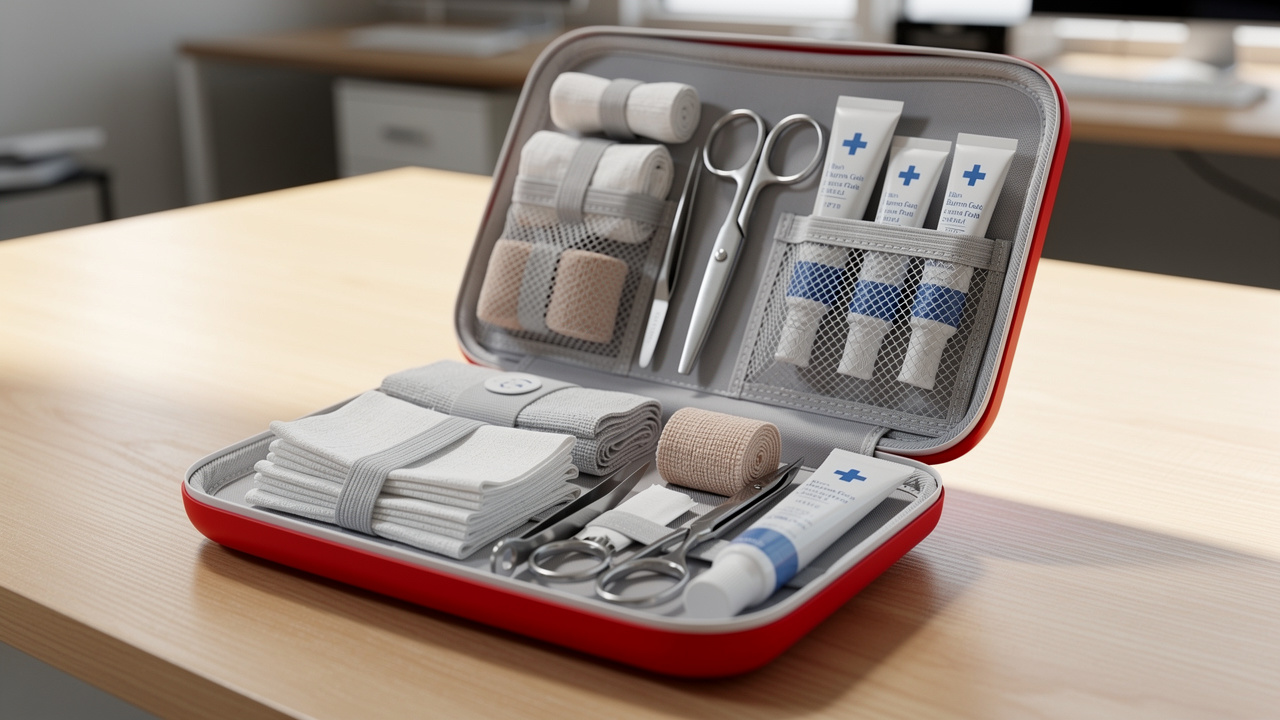
Before placing an order with any first aid manufacturer, ask for a documented item list and full compliance paperwork you can hand straight to an internal or external auditor. Confirm how flexible their minimum order quantities are and whether they offer component pack or refill programs, since that flexibility often separates a manufacturer built for long-term partnership from one built for a single transaction. Finally, ask directly about custom branding, OEM and ODM capability, and whether they can configure kits around your specific industry’s hazards.
What Compliance Standards Should Your First Aid Kits Meet?
Workplace first aid kits sold in the United States must satisfy OSHA 1910.151(b), which requires that adequate first aid supplies stay readily available wherever a workplace injury could realistically happen. Readily available, in practice, means kits sit within roughly three to four minutes’ travel of any work area, hold enough supplies for the headcount and hazard level on site, and stay clean, dry, and clearly marked at all times. ANSI/ISEA Z308.1 adds the content detail OSHA leaves open, splitting workplace kits into Class A kits for offices, retail spaces, and other lower-hazard sites with smaller workforces, and Class B kits for larger or higher-hazard operations like manufacturing floors and construction sites. Getting this classification wrong isn’t just a paperwork problem. OSHA penalties for missing or inadequate first aid supplies can reach five figures per serious violation, and willful or repeated violations climb well past that, which turns a sourcing decision into a direct financial exposure for the organization that got it wrong.
Industry-Specific Compliance Needs

Compliance isn’t a single checklist, because the hazards a construction crew faces look nothing like the hazards inside a commercial kitchen or a chemical lab. The table below breaks down a few of the most common industry-specific needs procurement teams should account for when building out kit contents.
| Industry | Primary Compliance Need |
|---|---|
| Construction and manufacturing | Enhanced trauma supplies, tourniquets, and splints |
| Food service | High-visibility bandages and extra burn dressings |
| Marine operations | Corrosion-resistant, waterproof containers |
| Labs and chemical facilities | Fast-access eyewash stations and burn response guidance |
How Do You Evaluate And Choose A Reliable UK-Grade Manufacturer?
Choosing a reliable UK-grade manufacturer comes down to a three-pillar framework that holds true regardless of industry or facility size. The first pillar is compliant kits matched to your actual workplace risks, the second is a scheduled maintenance and inspection routine that keeps those kits current, and the third is trained responders who know how to use what’s inside the box when it matters.
Cost matters too, but it should never outrank verification in that decision. Flexible minimum order quantities, replenishment programs, and transparent pricing are genuine value-adds worth asking about, but only after a manufacturer has already proven its CE certification, audit history, and documentation hold up to scrutiny.
The Takeaway
Choosing a CE certified first aid manufacturer in the UK isn’t a box to tick on a procurement form, it’s a decision that shapes how your organization responds the next time someone gets hurt on the job. Certificate numbers, ISO 13485 audit records, named distribution partners, and third-party lab reports aren’t bureaucratic extras, they’re the proof that separates a verified manufacturer from a listing that just looks the part.
If your current supplier can’t produce that paperwork without a delay, it’s worth asking why before your next contract renewal. First Aid Longs has built its reputation on in-house manufacturing, documented compliance, and on-time delivery for more than 100 clients worldwide, and a quick documentation request is the fastest way to see whether any supplier, including this one, actually measures up.